About SAMRUM
Who is behind it, how responsibility is divided, and why it was built.
What is SAMRUM?
SAMRUM is a structured conversation tool for families, built on each person's own test. Everyone answers an age-adapted test privately, gets a free profile, and the reports show the patterns in each relationship – partner, teenager, child or sibling – in language you can use at home. Developed in Denmark.
Who does what

Thomas Silkjær
Founder of SAMRUM
Product and technology
Thomas on LinkedIn
Henrik Pahus
Development consultant
Development and organisation
Henrik on LinkedIn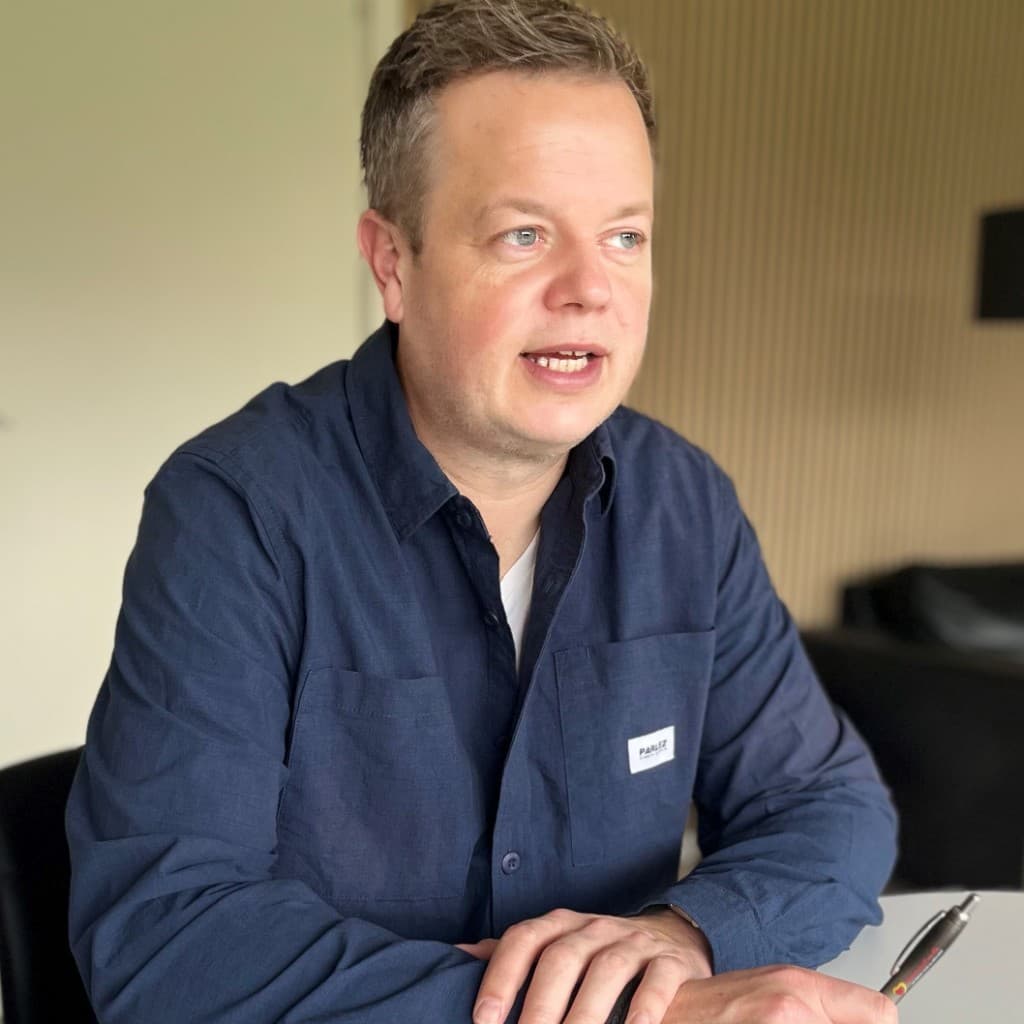
Filip Smidt
Professional advisor
Professional review of patterns and language
Filip on LinkedIn
Why I built it
My name is Thomas and I'm the founder of SAMRUM. I'm not a psychologist or therapist – I'm a tech person with personal experience. I've been in a relationship for more than 20 years and have two teenage daughters. We're quite different as people – and that's actually a strength. But it takes time to understand differences when you don't have a shared language for them.
I've tried therapy myself and I know what it can do. But I missed a tool you could use earlier – or in between – without it requiring a full course of treatment. Something that helps put words to what's happening, so you can have the conversation yourselves.
SAMRUM is that tool. It's not a replacement for therapy. It's a bridge – between "we're fine" and "we need help". And a starting point for the conversations that otherwise don't happen.
Henrik and Filip – in their own words
Henrik Pahus
Development consultant
I've spent 20 years working across public and private organizations in Denmark and abroad. My work has been about developing people and leaders – and about translating insight and experience into something people can actually use. That's also where SAMRUM clicks for me: a tool that helps people move from reflection to action.
Filip Smidt
Professional advisor
My name is Filip Smidt. I'm a qualified social educator and psychotherapist. Since 2001 I've worked with wellbeing – in couples, families, adolescence and workplaces – with a particular focus on how we affect each other and how even entrenched conflicts can become more manageable. My starting point is always to treat the problem as the problem, not the person. That's where SAMRUM fits for me: a tool that helps you understand your own behaviour and what's happening between you.
Patterns, not interpretation
Every report is anchored in at least one named, research-anchored pattern in your data – a dynamic that can be traced directly back to the scores you got in the test. The AI never writes without such an anchor. When the signal isn't strong enough, the report says so explicitly and sticks to falsifiable statements. This anchoring is what keeps SAMRUM from becoming free-form AI interpretation.
How is SAMRUM different from MBTI and Enneagram?
MBTI, Enneagram and similar typologies place you in a fixed category. SAMRUM uses a continuous framework.
- No types or labels – SAMRUM gives you 10 continuous tendencies, not a four-letter type.
- Grounded in well-established research – SAMRUM is built on OCEAN (Big Five) and IPC, two of the most studied personality frameworks in psychology. MBTI and Enneagram have more limited scientific validation.
- Built for relationships, not self-labelling – the reports describe patterns between you, not just who each of you is.
Data and methodology
The tests are built on OCEAN (Big Five) and IPC (Interpersonal Circumplex) – two of the most validated frameworks in personality research. We translate them into 10 family themes that are easier to talk from than abstract personality types.
Privacy and control
- No one can see each other's raw test answers.
- Sharing only happens when you actively choose it – this includes teenagers.
- If you work with a practitioner, the family always controls what is shared and when.
About AI
The AI never sees what anyone answered. It only receives the calculated patterns from the test results. What we do is structure data grounded in established personality research and translate it into language families can talk from. The AI is a translator, not a therapist.
Accessibility
The reports are built to be used in everyday life. You can read the full text, go through it guided one topic at a time, or listen to a short five- to six-minute summary. The audio has a paired transcript, so it meets WCAG 2.1 Level A (audio-only prerecorded). Good for people who'd rather listen – necessary for some.
Contact
If you have questions or feedback, feel free to write to me. I read everything and actively use feedback to improve SAMRUM.
Thomas – founder of SAMRUM
Do you work with families professionally? See how professionals use SAMRUM
Company information
- Company
- SAMRUM, xrplorer ApS
- Address
- Moesgårdvej 12B, 8270 Højbjerg, Denmark
- VAT
- DK41348534
- [email protected]
Written by Thomas Silkjær, founder of SAMRUMLast updated