Self-insight · Communication
We layered over 240 personalities on top of each other. No two were alike.
Are there really 16 personality types? We layered over 240 personality profiles on top of each other – and saw why relationships need more than boxes.
We took over 240 adult profiles from the SAMRUM test and layered them on top of each other in a single image. No two were alike – not a single one. That's not a flaw in the test. It's the point: people don't come in 16 versions, and that's why we clash in ways no type description can predict.
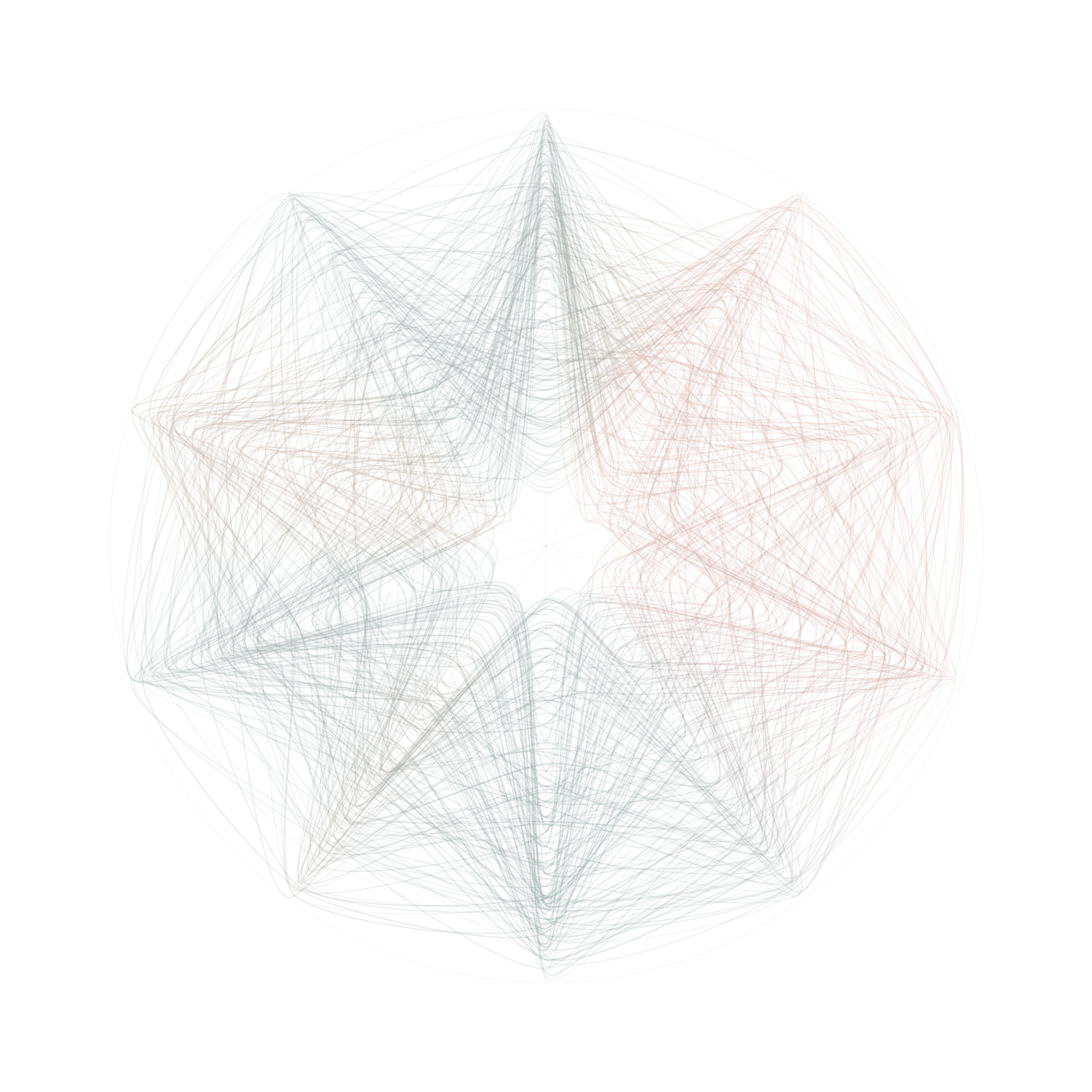
The image looks like a weave. Hundreds of thin lines crossing each other in every direction. Each line is a person: ten positions between 0 and 100 – one for each axis, showing where you sit compared to everyone else. Need for structure, social energy, warmth, boundaries, reactivity, repair after conflict, and four more.
If profiles naturally gathered into a few clear types, you'd expect to see distinct clusters in the image – 4, 8, 16 recognisable shapes. They aren't there. The lines spread out across the whole thing.
How alike are the two most alike?
We went looking for twins in the dataset. The closest we found: two profiles that still differed by up to 10 percentile points on a single axis. That may not sound like much, but in everyday life that kind of difference can look like something as ordinary as: one wants to tidy up the same evening, the other thinks it can easily wait until the weekend.
We also tried rounding off. If you reduce each axis to five rough zones – deliberately throwing away the nuance – only one single pair in the whole dataset shares the same shape. Even when you make people as blurry as possible, almost all of them are still different.
Are there really 16 personality types?
Personality types are popular because they're easy to grasp. "I'm an INFJ" is a sentence you can say at a dinner party. But typology works by rounding off: two people sitting on either side of a cutoff each get their own box – even though they're more alike than two random people in the same box.
Modern personality research typically describes traits as dimensions rather than fixed boxes: you're not either introverted or extroverted – you sit somewhere on a scale, and you do that on many scales at once. It's less catchy. But it's true, and the image above shows why: over 240 people, just as many shapes.
Curious about yourself?
9 questions. 2 minutes. No login required.
That's why we clash
If no two people are alike, it's no wonder we bump into each other now and then – including with the people we love. One needs a plan to relax. The other relaxes by not having one. One says things straight away. The other needs a walk around the block first.
Neither is wrong. But in everyday life those two ways meet again and again – at the breakfast table, in the car, on Sunday evening – and where they meet, patterns form.
Patterns are what we fall back on
A pattern isn't a trait you have. It's something that arises between two people: your way of reacting, meeting the other person's way of reacting. One pushes, the other withdraws, the first pushes harder. It runs in a loop – and it runs strongest when we're not paying attention to it.
That's why patterns feel like something that "just happens". We fall back on them precisely because we don't see them. The day you can point at the pattern – "there it is again" – it loses some of its power.
In our pattern library you can see some of the patterns SAMRUM can recognise, and the research they build on.
What AI does – and doesn't do
One thing is important to get straight: artificial intelligence doesn't find the patterns at SAMRUM. The patterns are calculated by transparent rules from two people's profiles – the same input gives the same answer every time. What AI does is translate: put words to the pattern and give examples of the everyday situations where it typically shows up, so it's recognisable at the kitchen table and not just in a graph.
You can read more about how the test and the calculations work in our methodology.
No two are alike. That's the good part.
This isn't scientific proof that personality types can never be used for anything. Types can be fine as conversation starters. But they cut hard. SAMRUM works with axes and patterns because relationships rarely go wrong in one big category. They go off track in small differences that repeat in everyday life.
If everyone were alike, there'd be nothing to discover. The differences aren't a problem to be solved – they're the reason it's interesting to get to know each other. But it helps to be able to see them. Not as boxes. As shapes.
About the data: the analysis covered exactly 244 adult profiles (June 2026) from users who consented to anonymised, aggregated use. The image only shows the combined weave – no individual can be singled out or recognised.